Emerging Tech Project Proposal
Overview
For my emerging tech project I wish to create a secondary virtual universe that simulates a dreamlike environment. I will use a virtual reality headset that utilises 360 art software in order to design multiple fantasy landscapes that the viewer can explore. I will aim for these scenes to emulate the look of a dream scenario by including mythical beings and elements that don’t make sense to the real world in order to give the viewer a way to escape.
I will also research into the use of VR art as a therapy form in order to create relaxing environments that benefit the user in a deeper way than regular 360 art. To achieve this I will incorporate the use of sound whether this may be through a guided meditation or ASMR.
Inspiration
Zaha Hadid
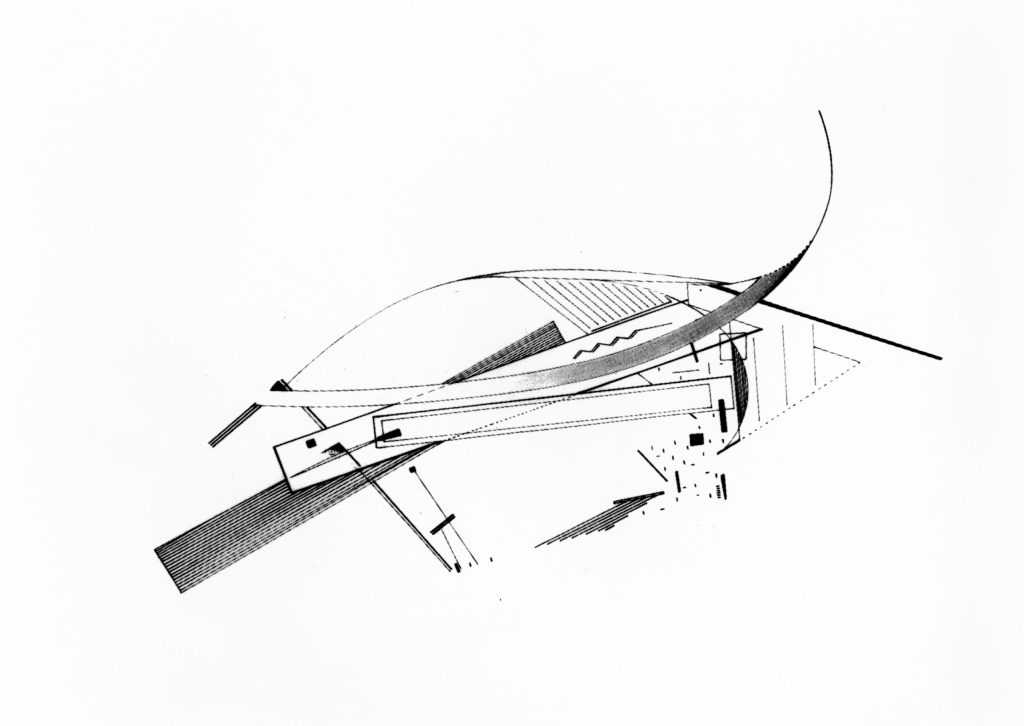
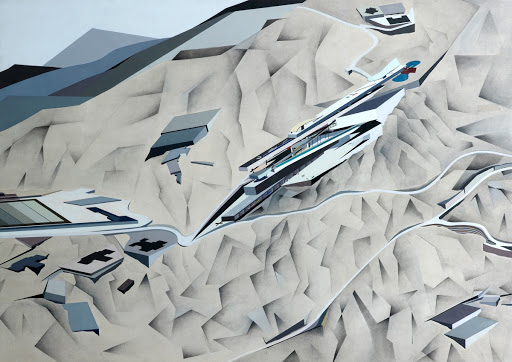
From the years 1982-83 an architect named Zaha Hadid known for her radical designs won the competition for “The peak”, an unbuilt club overlooking the city of Hong Kong, which in turn propelled her career forward as an artist. She used painting to develop her proposals and although these never came to fruition the artist partnered with Google Arts and Culture in order to create a 360 experience of her designs. By translating her work into the 3D world the viewer is able to fully immerse themselves into her metropolis and see her dynamic compositions through Zaha’s perspective. Furthermore, since her designs were so abstract and complex by designing them in a VR city it makes them a lot more digestible to the average viewer.
I will aim to achieve this in similar ways by immersing my own audience in the 360 dreamland and instead of the viewer seeing it from an architectural point of view I hope that it will provide therapeutic effects that aid in stress relief and relaxation.
Ewan Rose
On a slightly smaller scale this VR artist, Ewan Rose, uploads virtual art tutorials using open brush onto his Youtube channel. Not only does it display his high level of understanding on the software but will also be an extremely useful tool to users like me that are completely new to the software. His artwork also heavily relates to my own ideas for what I want to create with a lot of his tutorials featuring mythical creatures as well as scenic environments. I believe these elements could be used in a restorative sense to heal the mind and create calming scenarios for the user.
Classic Paintings Recreated in VR
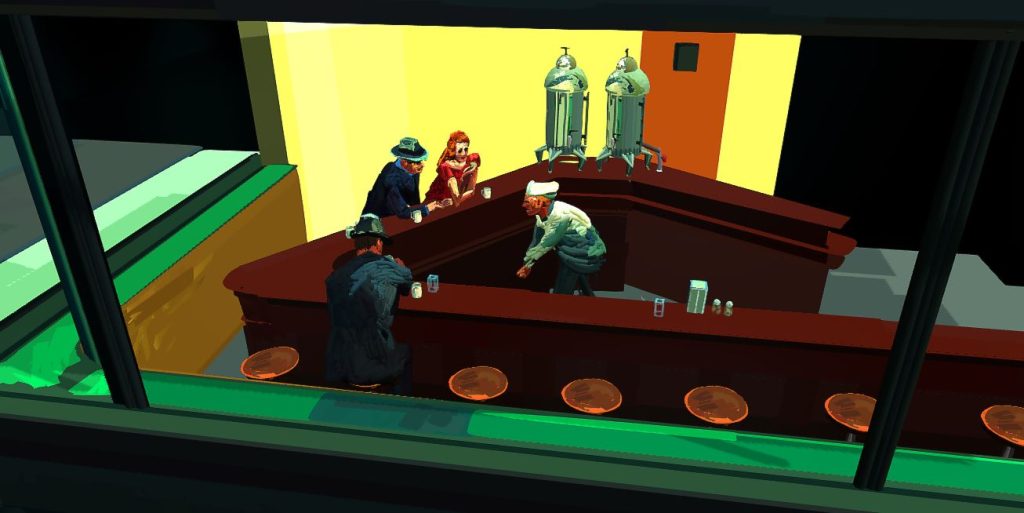
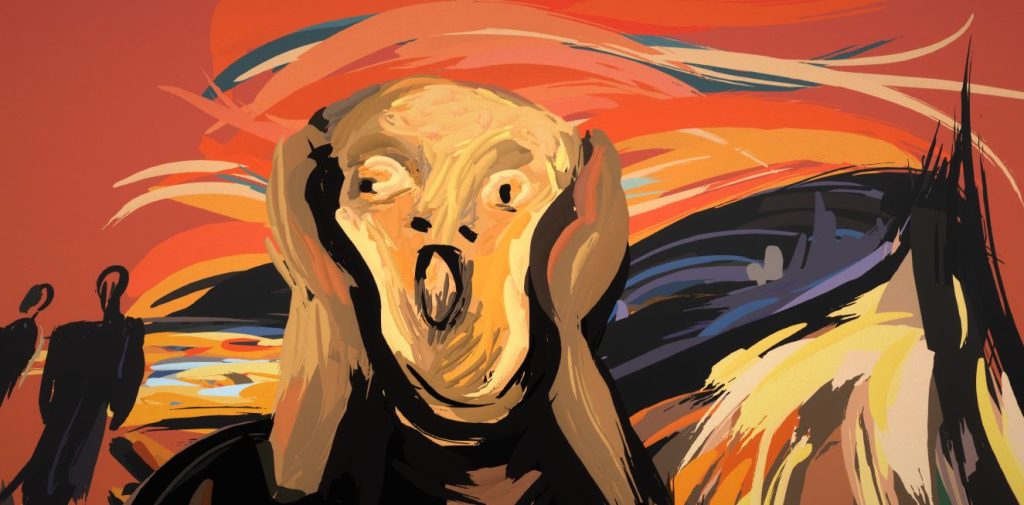
In the world of VR art the use of recreating famous scenes/traditional 2D art is very popular. By doing this it adds further levels and deeper meanings to the already complex artwork and allows the viewer to step into the painting and see it from a completely new perspective. Instead of surveying a simple static image the viewer can navigate around the scene and zoom in and out however they wish where they might be able to see brand new elements to the painting they wouldn’t have seen otherwise. The beauty of this also allows the artist to use their own creative freedom to choose how exactly it’ll be perceived from different angles as they currently don’t exist in the universe that the original artist of the work designed.
In the “Nighthawks” recreation the user can now sit themselves down into one of the vacant stools across from the other people in the canvas opening up new avenues for interactivity. The artist who recreating “The Scream” painting also chose to include interesting levels of interactivity by framing the 3D artwork within a black square reminiscent of that within an art gallery. This way the viewer can walk up to the seemingly 2D image but instead of simply viewing it they can step inside the art and walk around. This almost breaks the fourth wall and merges both of the 2 and 3 dimensional realities.
Storyboarding/Ideas
For my VR art experience I want to mimic the unnatural imagery seen in dreams and turn it into a 360 gallery with the aim of creating calming landscapes. I want to include mythical creatures and interesting backgrounds to add more wonder and awe to the pieces. This will allow me to add more variety of colours and other interesting elements.
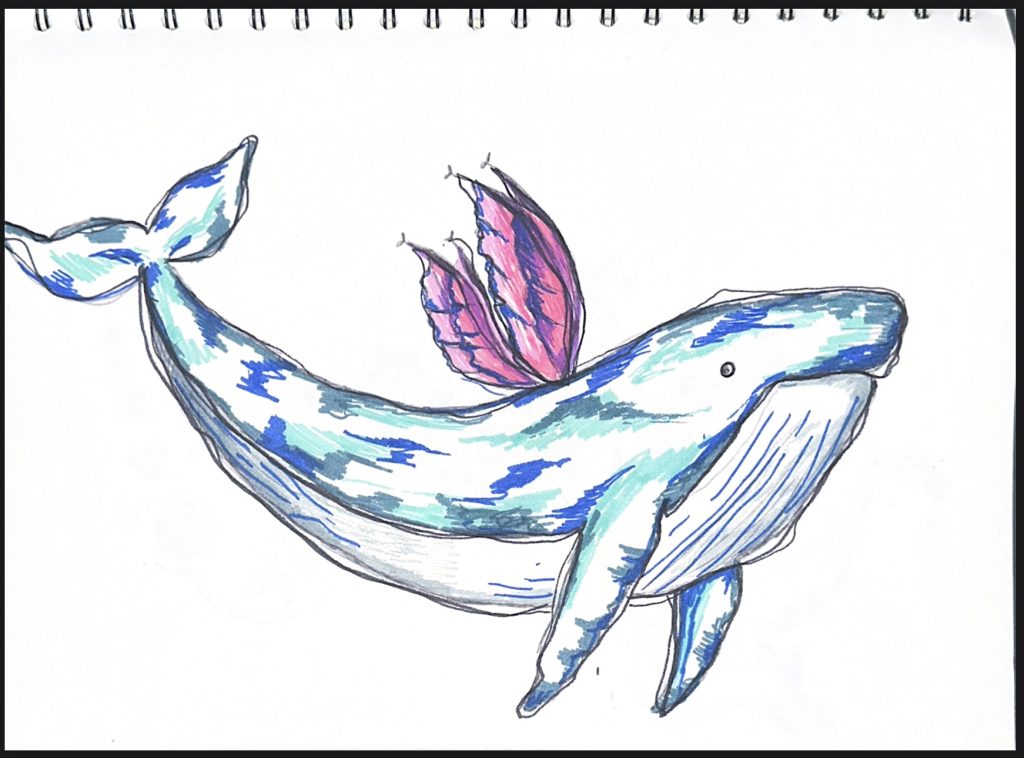
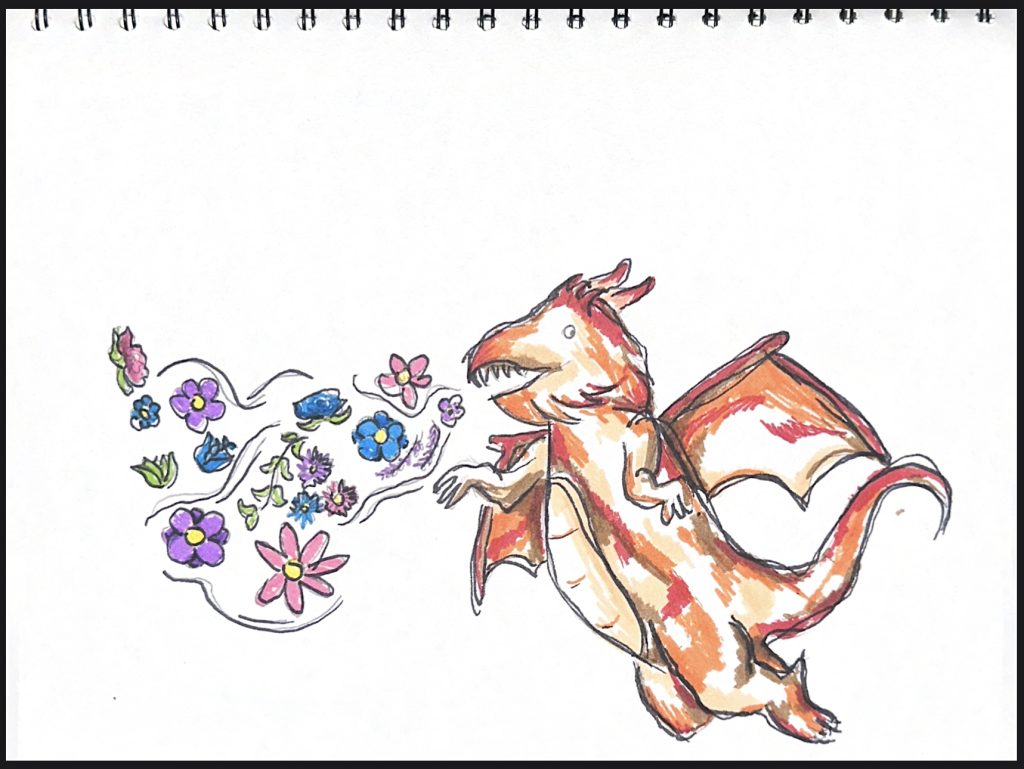
Here I quickly sketched out some potential ideas for the animals I wanted to put inside the world. Initially I wanted these animals to be as non-sensical as possible as dreams would also be by adding wings to the whale and making a flower breathing dragon however I instead decided that I want the animals to still make sense logically for the environment that they’d be set in so I’ve just gone with regular mythical creatures instead. I’ve also drawn these in a relatively cartoonish style in hopes to make it as easy as possible for me when transferring the art into a 360 space.
Once I had some basic ideas for how I wanted the style to look I moved onto outlining the specifics of my project into a basic storyboard. I’ve decided I wish to design 3 different scenes that are all clearly distinct in their own ways. I’ve called the first scene ‘Underwater Palace’ with a crowd of marine animals/mermaids swimming towards the said palace. The clear direction that the elements are all moving in will create a clear line of sight for the viewer and help them know which way they should walk in order to gain further inspection of the scene. The second one is called ‘Fairy Forest’ which will entail a night-time scene in the middle of the woods where a group of fairies are huddling together for a meeting. The viewer can then move towards the magical pool and see smaller details like the reflection of the moon in more detail. The third and final scene is titled ‘Above the Clouds’ where the viewer is placed in the sky and can walk along the clouds. A pegasus can be seen leading the viewer towards the rainbow where they’ll be able to slide over it.
I’ve tried to create scenes that I believe will elicit harmonious feelings of serenity and calm from the magical-esque environments. I’ve done this by choosing places that may evoke feelings of nostalgia for adults who may reminisce on older children’s shows/movies that look similar.
Depending on how successfully I create these scenes will determine on whether or not I will attempt to add animated elements. These will only be very small movements such as the bubbles floating up in the first scene or the fairies wings flapping in the second but I think would add something extra and interesting for the viewer to look at.
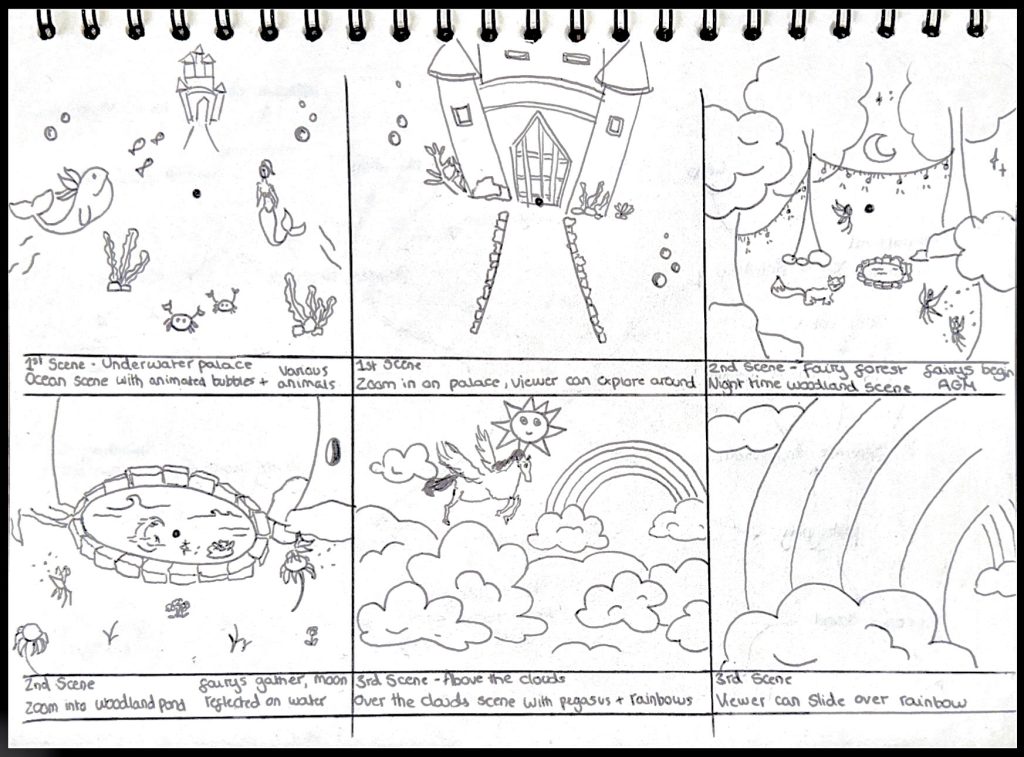
Storyboard for my ‘Sleep Walkers’ Project.
Virtual Art Therapy
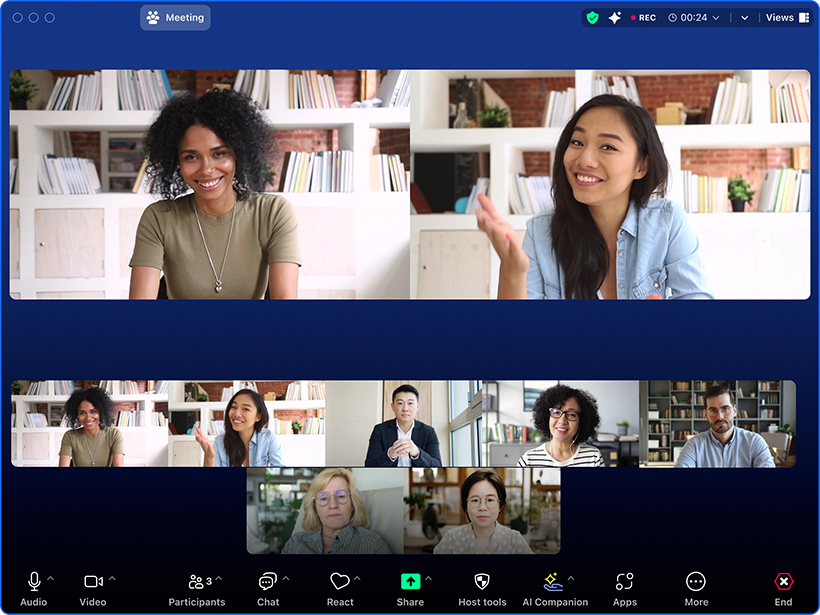
In the new age of digitisation and many once real-life practices turned online it’s important for different fields to integrate their way into the virtual world as that’s the direction that our society is moving in. Especially since the pandemic and living post-lockdown we’ve seen the rise of socialisation and e-commerce directly impacted as a result. This can be seen in the online application, Zoom, which saw its revenue skyrocket to $2.65 billion in 2021 from only $623 million the previous year (Richter, 2024) leading to the public understanding what a great tool it is within business and being used continuously afterwards. Covid also affected the way we shop with online spending being higher than pre-covid in 62 cities across the UK.

Virtual Reality Therapy (VRT) has become more widely used within recent years. It has proven to be effective with a study proving the success rate of it being around 66% to 90% of people with PTSD and has been shown to significantly help with pain relief in place of medication (JMIR Serious Games, 2022). VRT uses immersive design and sound to transport the patient into 3D environment either using a desktop or VR headset and can be used to treat a wide rage of mental health conditions such as, PTSD, Anxiety, Phobias and Depression.
These forms of therapy are often used in ways such as virtual talk therapy sessions where the client is speaking online to a virtual avatar with the added benefits of a hidden identity or being transported to a 3D environment where they can use exposure therapy to conquer fears. On the other Virtual Art Therapy is less spoken about and newer to the field of therapeutics but has been proven to have great potential.
There are 2 ways this medium can be utilised for therapy: viewing and interacting with the art or becoming involved with the actual art creation process. For this assignment I will need to upload a recording of what I’ve designed therefore it would not be possible to achieve the latter use of VR art and document individuals creating it. I will attempt to create immersive 3D art that provides calming qualities but to do this I need to take it a step further than simply letting the user view it which is why I will try to include effective sound design.
OpenBrush
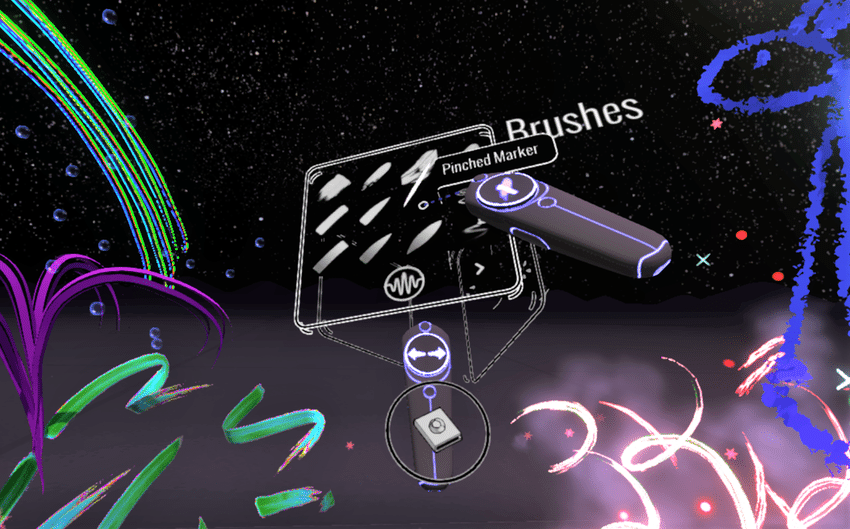
For my software of choice I have gone with Open Brush which is a community created evolution of the already existing Tilt Brush that allows you to paint in 3D through the use of a virtual reality headset. It is a free and open source application that provides a multitude of brushes and colours to allow you to create whatever you want. A useful function that it has is the use of the guides panel which holds various geometric shapes that can be dragged onto your 3D world and painted on top of to create completely equal shapes. This will be especially useful when it comes to painting circles as I can imagine they’d be the hardest to replicate in a uniform way each time.
For this project I will have to learn Open Brush from scratch. This will be a consideration I’ll have to take into account as I’ll need to allot space into my project planning in order to give me time to learn the software. However there are lots of resources and tutorials online that will aid me in this process.
Project Plan
Once I had decided what I wanted my project to be I drew a quick spider diagram that defines everything that I want to include within the project and the project research. This allowed me to get all my ideas onto paper quickly and see from what I had put down what I could extend and what else I needed to consider. I have also decided to name the project ‘Sleep Walkers’ with the obvious theme of the environments being a dream that the user is able to consciously walk through.
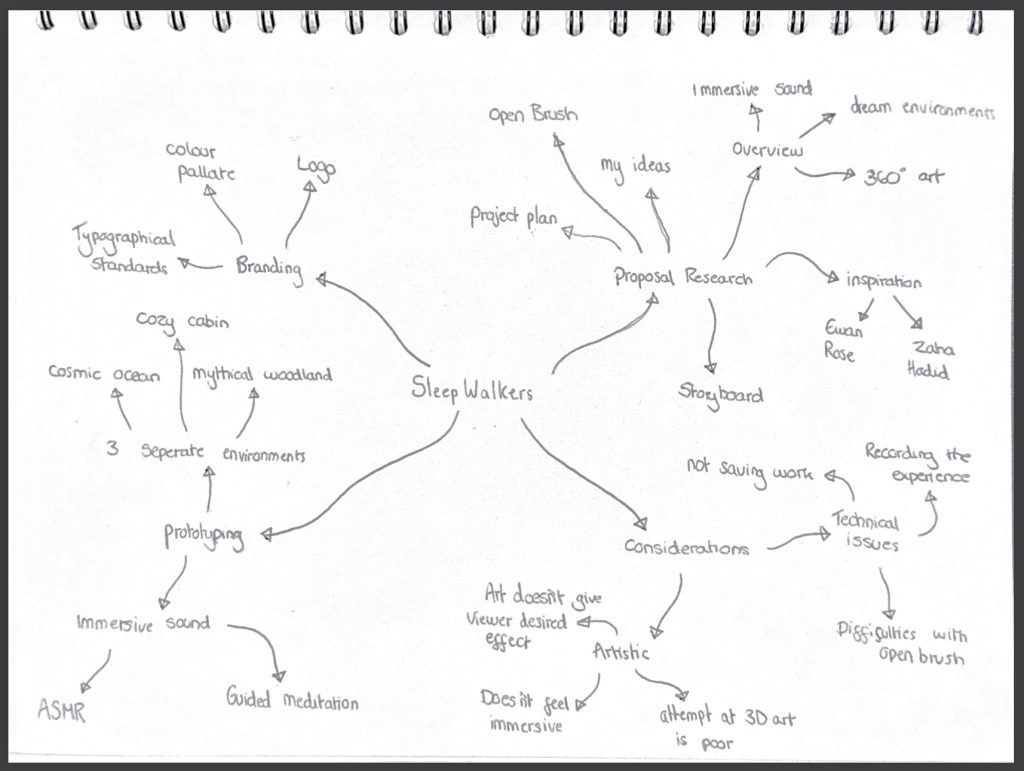
Spider digram of my ‘Sleep Walkers’ Project.
I’ve then made a process flowchart that displays the order in which I will complete my tasks and how I will work around any issues I may face.
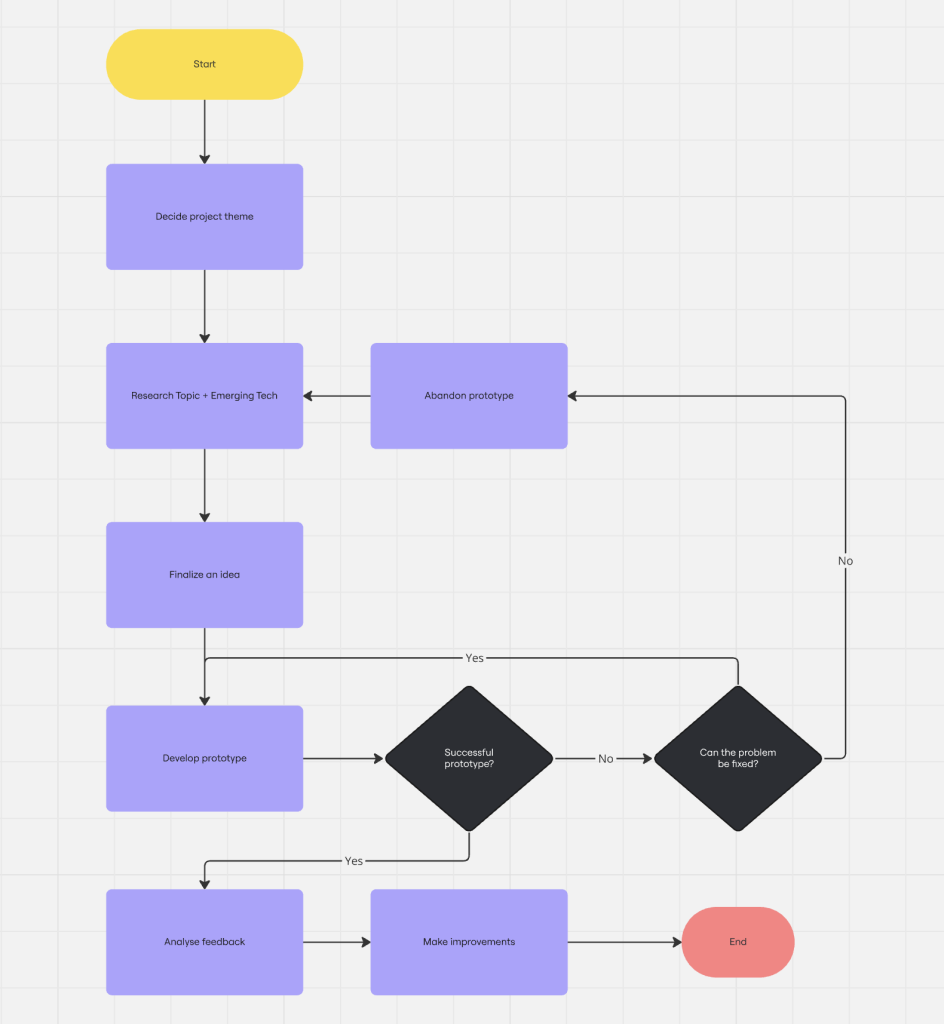
Flowchart of my work process for this project
Finally I made a Gantt chart on Excel that I will be able to refer to to see which tasks should be completed by what time. This will help keep my workflow organised
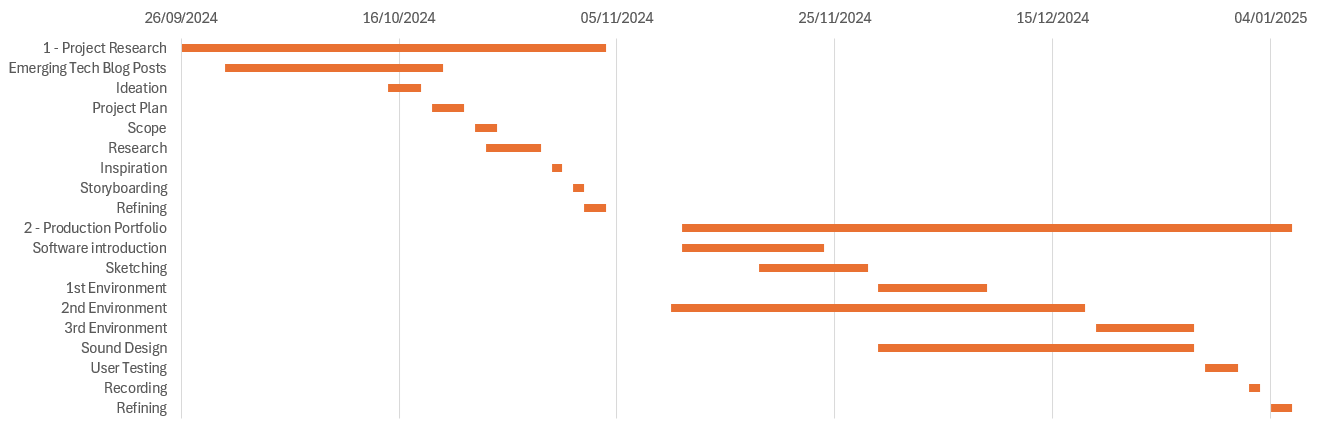
Gantt Chart I’ve created for this project
References:
- Serpentine. (2017) Zaha Hadid Virtual Reality Experience: The Peak [Video] Available at: https://www.youtube.com/watch?v=_X4RWvXkXV0 [Accessed 30/10/24]
- Zaha Hadid Architects. (1982) The Peak Leisure Club [Painting] Available at: https://www.zaha-hadid.com/architecture/the-peak-leisure-club/ [Accessed 30/10/24]
- Rose, E. (2021) Creating a Portal in VR! (Open Brush VR Art Process Video) [Video] Available at: https://www.youtube.com/watch?v=gnYm0MnubeY [Accessed 30/10/24]
- Google Arts and Culture. (2016) Zaha Hadid Virtual Reality Experiences: The Peak 1982-83 [Webpage] Available at: https://artsandculture.google.com/story/zaha-hadid-virtual-reality-experiences-the-peak-1982-83-serpentine-gallery/UwURF4uKY1WlIA?hl=en [Accessed 30/10/24)
- Richter, F. (2024) Zoom’s Post-Pandemic Growth Slows to a Crawl [Quote] Available at: https://www.statista.com/chart/21906/zoom-revenue/ [Accessed 02/11/24]
- Zoom Support. (2024) Adjusting your video layout during a virtual meeting [Photo] Available at: https://support.zoom.com/hc/en/article?id=zm_kb&sysparm_article=KB0063672 [Accessed 02/11/24]
- Frost, R. (2020) The benefits of moving to e-commerce [Photo] Available at: https://onefoursix.co.uk/the-benefits-of-moving-to-e-commerce/ [Accessed 02/11/24]
- Quinoa, V. (2023) Three years on from lockdown: has the pandemic changed the way we shop?[Webpage] Available at: https://www.centreforcities.org/publication/three-years-on-from-lockdown-has-the-pandemic-changed-the-way-we-shop/ [Accessed 02/11/24]
- Laurence, E. (2024) Virtual Reality Therapy: Everything You Need To Know. [Webpage] Available at: https://www.forbes.com/health/mind/virtual-reality-therapy/ [Accessed 02/11/24]
- Participant. (2017https://www.youtube.com/watch?v=te8hqLc_aZ0&t=3s YouTube the scream 04/11/24
- Peaslee, G. (2017) Nighthawks diorama Tilt Brush. [Photo] Available at: https://sketchfab.com/3d-models/nighthawks-diorama-tilt-brush-7d6c083ed7e743249040eaa195f0f678 [Accessed 03/11/24]
- Wagener, N. (2021) Reflecting on Emotions within VR Mood Worlds. [Photo] Available at: https://www.researchgate.net/figure/Rotatable-menu-in-OpenBrush-attached-to-one-controller-showing-the-brush-selection-menu_fig1_354823557 [Accessed 04/11/24]